
Overview
Many Muslim parents in the USA and Canada want their children to read the Quran with confidence, but finding local classes that fit school, sports, and family schedules is not always easy. Online lessons have made Quran education far more accessible. Still, parents are right to ask questions first. Will it actually work? What should my child learn first? How do I know a teacher is qualified?
This guide answers those questions in plain language. If you are researching how to learn to read Quran online for kids, you will find a clear learning path, practical tips for choosing a program, and simple ways to support your child at home.
Why Learning to Read the Quran Early Matters for Children
Reading is the skill that opens every other part of a child’s Quran journey. A child who reads confidently can recite in prayer, follow along at the mosque, and later study Tajweed or meaning with far less frustration.
Starting early helps for practical reasons:
- Young ears adapt quickly. Children pick up new sounds more easily, including Arabic sounds that do not exist in English.
- Good habits form first. Correcting a mispronounced letter is harder after years of repeating it.
- Confidence builds early. A child who can read is far more likely to enjoy Quran time.
Parents do not need to know Arabic themselves. They need a clear plan and the right support, which is why many families explore how to learn to read Quran online for kids in a way that fits busy weekday schedules.
This matters even more for non-Arabic-speaking families. Many children in North America hear English at home and at school, so Arabic reading needs deliberate, structured teaching.
How to Learn to Read Quran Online for Kids: A Step-by-Step Path
Short answer: Children learn to read the Quran in stages: Arabic letters, short vowels, connecting letters into words, and finally reading Quran text with correct pronunciation. In online classes, a live teacher guides each stage over video and corrects mistakes as they happen.
- Recognize each Arabic letter and say its sound correctly.
- Learn the short vowel marks (harakat) that change how a letter sounds.
- Blend letters into syllables, then into whole words.
- Learn common reading signs such as sukoon and shaddah.
- Read short Quran passages aloud with the teacher.
- Build fluency through repetition, review, and steady practice.
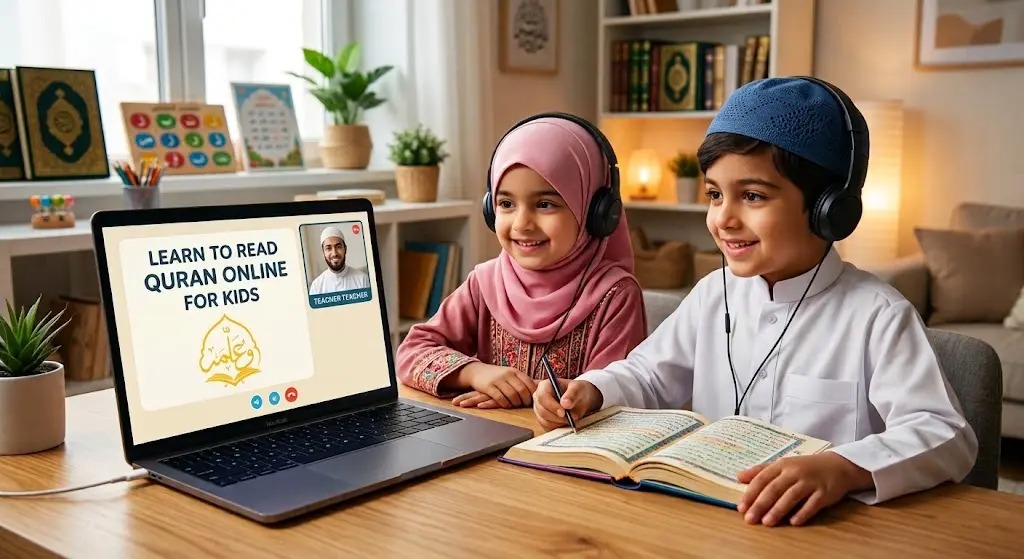
Online lessons work well because the child sees and hears the teacher, follows the same text on screen, and gets feedback immediately. Whatever program you choose, the smartest way to learn to read Quran online for kids is to move one step at a time. Skipping ahead often creates gaps that show up later as slow or hesitant reading.
What Children Learn First When Starting Quran Reading
Short answer: Beginners start with the Arabic letters: their names, shapes, and correct sounds. Vowels and connected words come only after that.
Along the way, children develop several useful skills:
- Recognizing letters at the beginning, middle, and end of a word
- Producing sounds from the correct part of the mouth and throat
- Reading short vowels accurately
- Blending letters smoothly instead of sounding out one by one
- Listening closely and repeating what they hear
- Focus, patience, and a regular study habit
Why correct pronunciation matters
Some Arabic letters sound alike to an untrained ear, yet a small change in sound can change a word. Early attention to Quran pronunciation for children prevents habits that are difficult to undo later.
Where Tajweed fits in
Tajweed is the set of rules for reciting the Quran correctly. For young beginners, it is introduced gradually and in simple form once basic reading is steady. It is not a separate hurdle to clear before starting; it grows naturally out of good reading habits.
The Role of Noorani Qaida in Learning Quran Reading
Noorani Qaida is a beginner’s primer that teaches Arabic letters, vowels, and basic reading rules in small, ordered steps, so a child can move on to reading the Quran itself.
Its graded structure makes it popular for Noorani Qaida for kids, especially children who do not speak Arabic at home. Most children learn to read quran online for kids and complete the Qaida stage before moving into the Quran text, although pace varies from child to child.
Signs your child is making progress
- They recognize letters without long pauses.
- They read short words smoothly, not letter by letter.
- They notice and fix their own mistakes.
- They can repeat a lesson’s key points in their own words.
- Their teacher says they are ready to move to the next stage.
What to Look For When Choosing a Program to Learn to Read Quran Online for Kids
Short answer: Look for a qualified teacher, a step-by-step curriculum, live interaction, regular feedback, and a trial lesson so you can see the teaching style first.
Here is what parents should look for in an online Quran class:
- A patient, qualified teacher with experience teaching children and a solid grounding in Tajweed.
- A structured curriculum that begins with letters and Qaida rather than jumping straight into surahs.
- Live lessons with real-time correction, not only pre-recorded videos.
- Age-appropriate lesson length that respects your child’s attention span.
- Clear progress updates you can understand even without Arabic.
- Scheduling that suits North American time zones and school hours.
- A trial lesson before you commit.
Do not be shy about asking questions. How does the teacher correct pronunciation? How is progress tracked? What happens if my child struggles? Before you commit to any option to learn to read Quran online for kids, book a trial and watch how the teacher interacts with your child. A warm, patient manner matters as much as credentials.
Why Live One-to-One Quran Lessons Can Help Children
Reading mistakes are personal. One child confuses two similar letters, another rushes through vowels. In a one-to-one lesson, the teacher hears every sound your child makes and can adjust the pace immediately.
Group classes can also work, particularly for children who are motivated by peers, but beginners may receive less individual correction. Whether one-to-one lessons are available depends on the provider, so ask about the class format before enrolling.
How Online Quran Reading Classes Keep Children Engaged
Children lose focus quickly on screens, so good teachers plan for it. Effective online Quran classes for kids often include:
- Short activities that change every few minutes
- Echo reading, where the child repeats after the teacher
- Quick review of previous lessons before new material
- Specific, encouraging feedback
- Small goals the child can actually achieve each week
The aim is a child who looks forward to lessons, not one who is pushed through them. That matters a great deal when you learn to read Quran online for kids, because lessons happen at home, where distractions are close by.
How Parents Can Support Quran Reading at Home
Parents who do not read Arabic can still play a major role. Your job is not to teach the letters. It is to protect the routine that helps your child learn to read Quran online for kids week after week. Here are ways parents can support their child:
- Choose a fixed time and a quiet space for lessons and practice.
- Test the device, camera, and audio before each class.
- Encourage short daily practice. Ten to fifteen minutes usually beats one long session.
- Ask your child to "teach" you what they learned that day.
- Praise effort, not only accuracy.
- Stay in touch with the teacher about progress and difficulties.
- If you are unsure about a pronunciation, note it for the teacher rather than guessing.
Common Challenges Children Face When Learning Quran Reading Online
- Short attention span. Keep practice brief and ask the teacher about shorter activities.
- Similar-sounding letters. Repetition and listening drills usually help most.
- Screen fatigue and distractions. A quiet space and a device used only for class can make a real difference.
- Discouragement. Celebrate small wins and remind your child that everyone starts at the beginning.
- Missed lessons. Ask about make-up options and try to keep the weekly rhythm steady.
Every child reaches a plateau at some point, and that is normal. With steady support, a child can still learn to read Quran online for kids even after a slow month. Patience and review do more than pressure ever will.
How Wa’allamah Institute Helps Children Learn to Read Quran Online for Kids
Wa’allamah Institute is an online Quran and Arabic learning institute. Its Quran and Arabic classes are paid programs. Parents can book a free trial lesson to experience the teaching approach before deciding whether to enroll. The trial is a chance to meet the teacher and see how your child responds; it does not make the regular courses free.
Several programs listed on the Wa’allamah website connect directly to the journey described above:
- Quran for Kids: a program for children beginning their Quran reading journey.
- Noorani Qaida: the beginner foundation covering letters, vowels, and basic reading.
- Arabic for Kids: supports children’s familiarity with Arabic letters and language.
- Tajweed & Recitation: helps students refine accurate recitation once basic reading is steady.
As children grow, families can also explore Islamic Studies and Quranic Qira’at, though these are separate from a beginner reading path. For families who want a structured way to learn to read Quran online for kids, Quran for Kids and Noorani Qaida are natural starting points. Please check each course page for current levels, schedules, and pricing.
Frequently Asked Questions About learn to read quran online for kids
Can children learn to read the Quran online?
Yes. Children can learn Quran reading online when lessons are live, structured, and taught by a qualified teacher. Video classes let the teacher hear and correct pronunciation in real time. Results depend on the quality of teaching and regular practice at home, so choose a program that lets you try a lesson first.
What is the best age for a child to start learning Quran reading?
Many children can begin around ages 4 to 6, once they can sit for short lessons and repeat sounds. There is no strict cutoff, and older beginners can learn successfully too. Readiness matters more than age: can your child focus for a short lesson and follow simple instructions?
Does my child need to know Arabic before learning to read the Quran?
No. Beginners start with the alphabet and sounds, so no prior Arabic is needed. Reading the Quran and understanding Arabic are different skills. Children first learn to decode letters and vowels accurately, and they can study meaning and vocabulary later.
How long does it take a child to learn Quran reading?
There is no fixed timeline. Progress depends on age, attention, lesson frequency, and home practice. A child who practices between classes as they learn to read Quran online for kids will usually advance faster than one who only studies during lessons. Your teacher can give a realistic estimate after assessing your child.
Is Noorani Qaida useful for children learning Quran reading?
Yes. Noorani Qaida introduces letters, vowels, and basic reading rules in a gradual sequence, which suits beginners and non-Arabic speakers. It builds accuracy before children open the Quran text, making later reading and Tajweed easier to learn.
How can parents help children practice Quran reading at home?
Set a consistent time, keep sessions short, and ask your child to read aloud or explain the day’s lesson. Praise effort, avoid comparing them with other children, and share any difficulties with the teacher. Regular, relaxed practice is more effective than occasional long sessions.
Final Thoughts
Teaching a child to read the Quran is a gradual process, and it does not need to feel overwhelming. Start with letters, build through Noorani Qaida, keep practice short and regular, and choose a teacher who corrects with kindness. If you are ready to learn to read Quran online for kids, a trial lesson is a low-pressure way to see whether a program fits your child. May Allah make your child’s Quran journey easy and blessed.
Ready to Get Started?
Explore the Quran for Kids program at Wa’allamah Institute or book a free trial lesson to experience the teaching approach first-hand. Please note that regular Quran and Arabic courses are paid; the free trial is an introductory lesson for parents and children to see if the program is the right fit.