
Overview
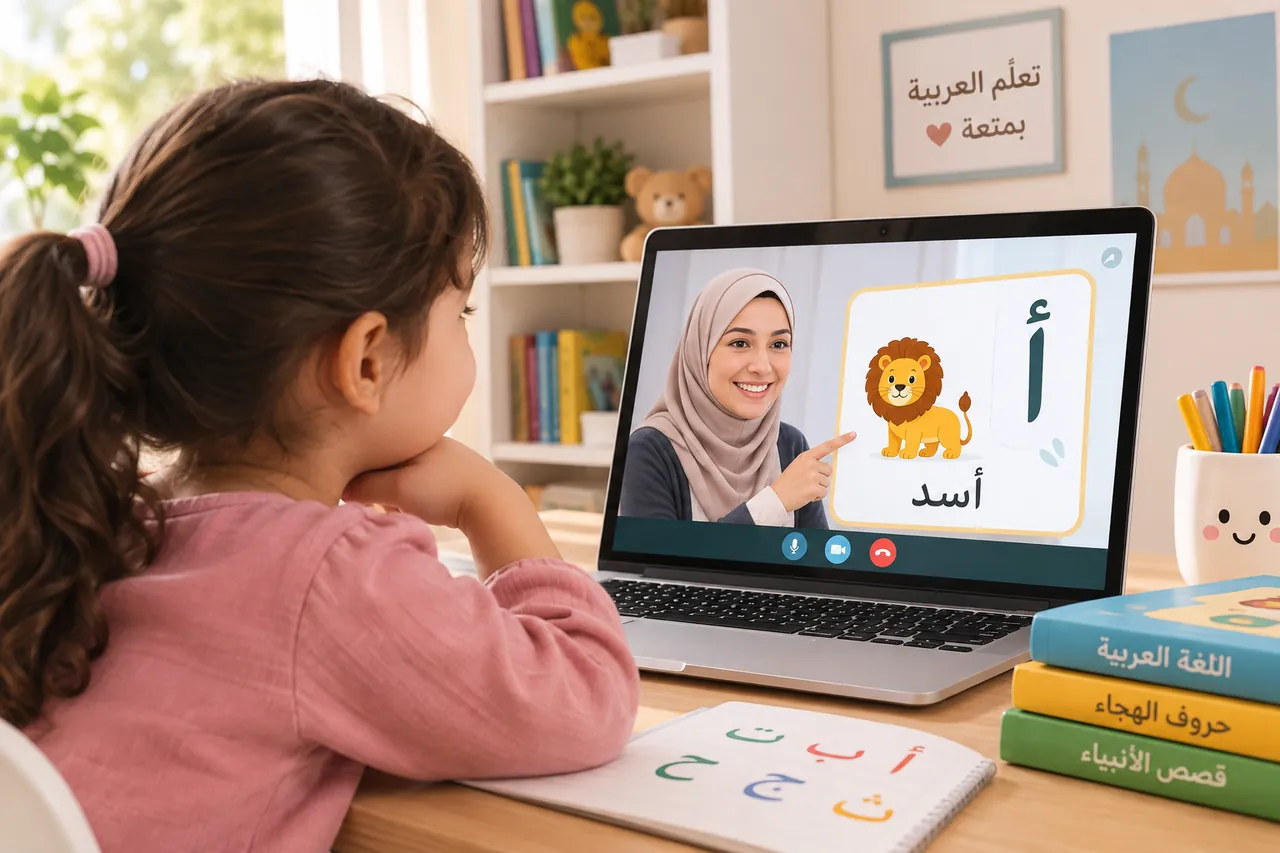
Parents across the United States and Canada are increasingly searching for a reliable online Arabic tutor for kids, whether they want their child to connect with family heritage, communicate with Arabic-speaking relatives, or build a foundation for reading the Quran. With busy school schedules, after-school activities, and long commutes to in-person classes, online learning has become a practical way for families to fit language education into daily life without sacrificing quality.
This guide walks through what online Arabic tutoring actually looks like, what to look for in a qualified tutor, and how to choose a program that genuinely fits your child's age, background, and goals.
Why Parents Are Choosing Online Arabic Lessons for Kids
Learning Arabic offers real benefits for children, especially those growing up in non-Arabic-speaking households in the US and Canada. Beyond communication skills, Arabic literacy opens the door to Quranic Arabic for Muslim families who want their children to read and understand the Quran rather than rely solely on translation.
Online Arabic classes for kids have grown in popularity for a few practical reasons:
• Flexibility across time zones. Families in different states and provinces can schedule sessions around school, sports, and family commitments.
• One-on-one attention. Many programs pair a child with a dedicated Arabic teacher for kids rather than placing them in a large group.
• Learning from home. There's no commute, which matters for families juggling multiple children's schedules.
• Access to native and fluent speakers. Finding a qualified Arabic language tutor locally can be difficult; online platforms widen the pool of available instructors.
• A calm, familiar environment. Some children, particularly younger ones or beginners, feel more comfortable learning at home than in an unfamiliar classroom.
For many families, the search for a dependable online Arabic tutor for kids starts with wanting consistency: the same teacher, a predictable schedule, and steady progress over time, rather than one-off lessons that don't build on each other.
What Does an online arabic tutor for kids Actually Do With Your Child?
An online Arabic tutor for kids works with a child through live video sessions, typically one-on-one or in very small groups, to build skills in listening, speaking, reading, and writing Arabic. Unlike self-paced apps, a live tutor can adjust the lesson in real time based on how a child is responding, correct pronunciation as it happens, and keep a young learner engaged.
A typical session may include:
1. A warm-up review of previously learned letters, vocabulary, or phrases.
2. Guided practice reading or sounding out Arabic letters and words.
3. Speaking practice through simple conversation, repetition, or games.
4. Writing practice, depending on the child's age and level.
5. A short recap so parents can see what was covered and what to reinforce at home.
For Muslim families, some tutors also connect Arabic language lessons to Quranic vocabulary and phrases, which can make Quran memorization and recitation more meaningful because the child understands the words rather than just repeating sounds.
What to Look for in a Qualified Arabic Tutor for Your Child
Not every program or teacher is a good match for every child. Before enrolling, it helps to know what separates a genuinely effective online Arabic tutor for kids from a lesson that simply fills time.
1. Experience Teaching Children, Not Just Arabic
Speaking Arabic fluently and knowing how to teach a seven-year-old are two different skills. Look for a tutor or program with specific experience working with children, including age-appropriate pacing, patience, and the ability to keep young learners engaged for the length of a session.
2. A Clear, Structured Curriculum
A good online Arabic tutor for kids should follow a curriculum that builds skills progressively, rather than jumping between random topics. Ask whether the program has defined levels, a way to track progress, and a plan for what a child will be able to do after a few months of consistent lessons.
3. Live, Interactive Sessions
Live interaction matters, especially for younger children. A tutor who can hear a child's pronunciation, correct it in the moment, and adjust the pace based on the child's mood and attention span will generally get better results than a recorded course alone.
4. Communication With Parents
Parents in the US and Canada often want visibility into what their child is learning, especially when they don't speak Arabic themselves. Programs that provide session notes, progress updates, or regular check-ins make it easier for parents to support learning at home, even without an Arabic background.
5. Alignment With Family Goals
Some families want conversational Arabic. Others want their child to read Arabic well enough to understand the Quran, or to prepare for subjects like Tajweed and Quran recitation later on. A good tutor asks about these goals early and shapes lessons accordingly, rather than using a one-size-fits-all approach.
Online arabic tutor for kids Learning at Different Ages and Stages
Children learn differently depending on their age, so it helps to know roughly what to expect at each stage when evaluating an online Arabic tutor for kids.
• Early learners (ages 4-6): Focus is usually on letter recognition, sounds, basic vocabulary, and short phrases, often through songs, games, and repetition rather than formal reading and writing.
• Elementary-age children (ages 7-10): Lessons typically move into reading short words and sentences, expanding vocabulary, and starting simple writing practice alongside continued speaking practice.
• Older children and preteens (ages 11+): At this stage, children can usually handle more structured grammar, longer reading passages, and more independent conversation practice, along with vocabulary connected to Quranic Arabic if that's a family goal.
Every child progresses at a different pace, so a program that adjusts to the individual child, rather than pushing everyone through the same fixed timeline, tends to work better than a rigid, one-size-fits-all class.
Is Online Arabic Tutoring Effective for Kids?
Yes, when the program is structured well and matched to the child's age and attention span. Live, one-on-one online lessons allow a tutor to give a child focused attention that's harder to replicate in a large in-person classroom, and video call technology has become reliable enough that connection quality is rarely an obstacle for most US and Canadian households.
That said, effectiveness depends heavily on consistency. A child who attends regular, well-structured sessions with the same online Arabic tutor for kids over several months will generally make more progress than a child who takes occasional, disconnected lessons. Short, frequent sessions tend to work better for young children than long, infrequent ones.
Questions to Ask Before Choosing an Online Arabic Program
Before committing to a program, it's worth asking a few direct questions:
• What is the tutor's or teacher's experience working with children specifically?
• Is there a defined curriculum, and can you see how it progresses over time?
• How are lessons structured, and how long is each session?
• Will my child work with the same teacher consistently, or a rotating group of instructors?
• How does the program communicate progress to parents?
• Is there a trial or assessment lesson available before enrolling in paid classes?
• Does the program also offer related subjects, such as Quran or Islamic studies, if that's relevant to our family?
Asking these questions upfront helps parents avoid switching programs repeatedly, which can be frustrating for a child who is just starting to build momentum.
A Note for Muslim Families: Arabic and Quran Learning Together
For many Muslim families in the US and Canada, the goal of finding an online Arabic tutor for kids is closely tied to Quran education. Understanding Arabic vocabulary and grammar makes it easier for children to eventually read the Quran with comprehension, not just recitation.
This is where a program like Wa'allamah can be a relevant option for families looking for structured online Arabic learning for children within an Islamic educational framework. Wa'allamah offers a range of programs for children, including Arabic for Kids, Quran for Kids, Noorani Qaida for beginners, Tajweed and Recitation, Islamic Studies, and Quranic Qira'at for more advanced learners.
Rather than treating Arabic and Quran education as separate tracks, this kind of structured approach allows a child's Arabic vocabulary to reinforce their Quran learning, and vice versa. For a family that wants both language skills and religious education in one place, working with an online Arabic tutor for kids through a program that also covers Quran and Islamic studies can simplify scheduling and create a more connected learning experience.
Wa'allamah offers a free trial or assessment class so parents can see how a lesson is structured and how their child responds to the teaching style before enrolling in the paid program. This kind of trial session is worth taking advantage of regardless of which provider a family chooses, since it gives both the parent and child a real sense of the pace, teaching approach, and personality of the tutor.
Families interested in exploring specific programs can look into pages such as Arabic for Kids, Quran for Kids, Tajweed & Recitation, Noorani Qaida, and Islamic Studies to compare what each course covers, or review available teacher profiles and enrollment plans before booking a session.
Frequently Asked Questions
At what age can a child start learning Arabic online?
Many programs accept children as young as four or five, using age-appropriate methods like songs, games, and visual aids. The right starting age depends on the child's attention span and interest rather than a strict cutoff.
How long does it take for a child to become conversational in Arabic?
This varies widely based on lesson frequency, consistency, and the child's age. Children who attend regular sessions and reinforce learning at home tend to progress faster than those with irregular attendance.
Do online Arabic lessons work as well as in-person classes for kids?
For many children, yes. Live, one-on-one video sessions allow the same personal attention as in-person tutoring, with the added benefit of flexible scheduling and access to a wider pool of qualified teachers.
Is it necessary to speak Arabic at home for a child to learn effectively?
No. Many children learning with an online Arabic tutor for kids come from households where Arabic isn't spoken. A structured program builds skills from the beginning regardless of the family's language background.
Can Arabic lessons for kids be combined with Quran learning?
Yes, and for many Muslim families this combination is the main goal. Programs that teach Arabic vocabulary alongside Quranic Arabic can help children move from simply reciting the Quran to understanding what they're reading.
What should parents look for in a free trial lesson?
A useful trial gives parents a sense of the tutor's teaching style, how well the tutor connects with the child, and whether the lesson structure matches the family's goals. It's a chance to evaluate fit before committing to paid, ongoing classes.
Getting Started
Choosing the right online Arabic tutor for kids comes down to matching your child's age, goals, and personality with a structured, consistent program and a teacher who genuinely enjoys working with children. Whether your priority is conversational Arabic, Quranic literacy, or both, taking the time to ask the right questions upfront makes it far more likely your child will stay engaged and keep progressing.
If you're a parent in the US or Canada looking for structured Arabic learning combined with Quran and Islamic education, consider exploring Wa'allamah's programs, including Arabic for Kids and Quran for Kids, or book a free trial/assessment class to see whether it's the right fit for your child before enrolling in paid lessons.